
Five scattered habits rarely survive a busy week. One integrated routine has a much better chance, because it removes the decision fatigue of figuring out what to do each day and replaces it with a simple rotation you can follow on autopilot. This routine is built directly around the five capacities from the five simple tests that reveal how resilient your body really is: lower-body strength and mobility, grip and muscular endurance, upper-body endurance, balance, and cardiorespiratory capacity. Instead of treating those as five separate projects, this routine trains all five in about 15 minutes a day, most days of the week.
In This Article
The Weekly Structure
The routine rotates through three types of days. You don’t need special equipment or a gym membership to follow it, and it’s built to flex around a body that doesn’t always cooperate on schedule.
Strength & mobility days (2–3x per week)
Bodyweight squats, sit-to-stand practice, and hip and ankle mobility work — the movements the sitting-rising test actually measures. This is where you build the leg strength and coordination that test captures in a single motion.
Balance days (most days, 2–3 minutes)
Single-leg stance practice, layered onto something you’re already doing — brushing your teeth, waiting for coffee. Balance is the capacity that responds fastest to small, frequent practice, so it doesn’t need its own dedicated day.
Endurance days (2–3x per week)
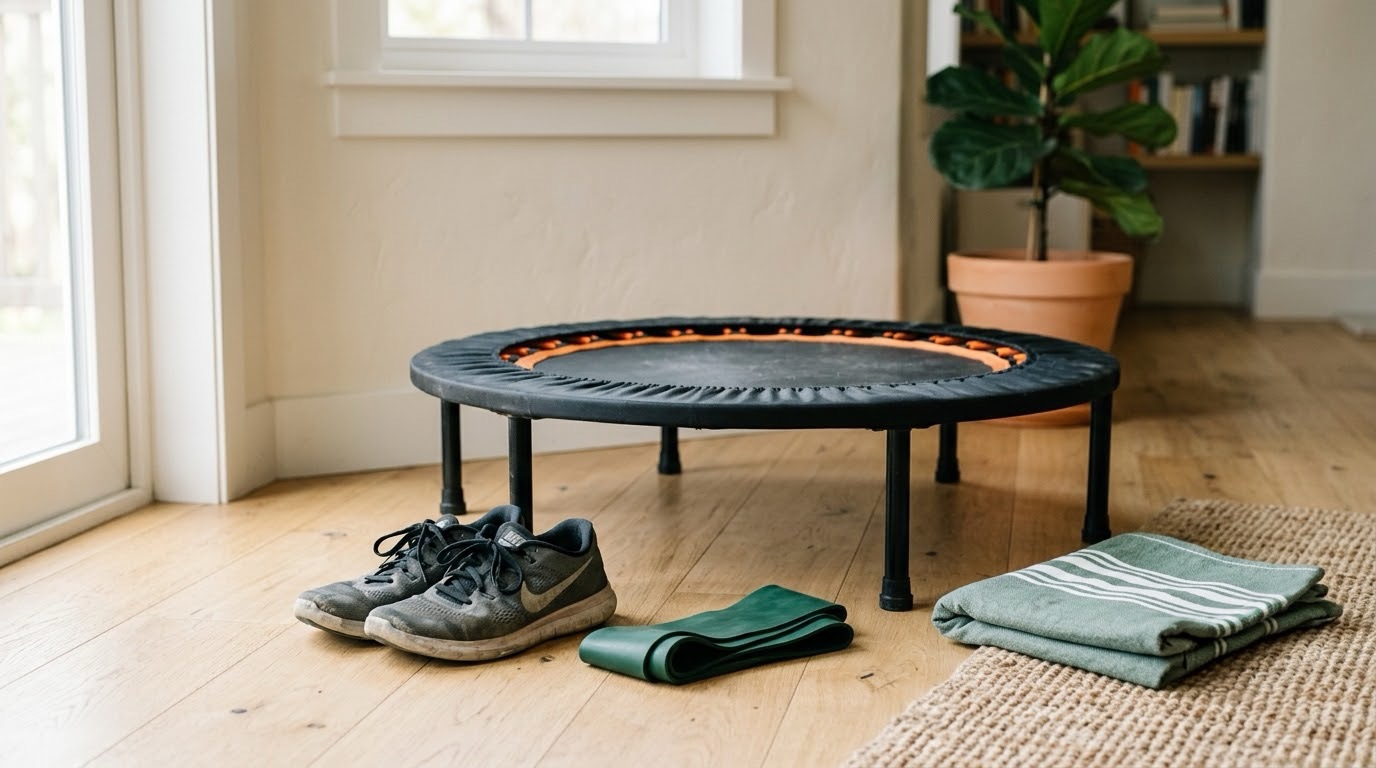
A brisk walk, a bike ride, rebounding on a mini trampoline, or any sustained activity that gets your heart rate up and keeps it there for 10 to 15 minutes. This is the capacity with the deepest research behind it, and it’s also the most forgiving in terms of what counts — rebounding in particular is worth knowing about if joint impact is a limiting factor, since it raises your heart rate without the pounding of running or brisk walking on pavement.
A Sample 15-Minute Session, Movement by Movement
Here’s what a single strength and mobility day actually looks like, start to finish:
- Minutes 1–3 — Mobility warm-up. Hip circles, ankle rolls, and a few slow bodyweight squats to wake up the joints you’re about to load.
- Minutes 4–8 — Strength work. Bodyweight squats or sit-to-stands from a chair, 3 sets of 8–10, resting as needed between sets. Add lunges once squats feel manageable.
- Minutes 9–11 — Grip work. A farmer’s carry down the hallway and back (holding something with real weight in each hand), or a dead hang from a doorframe bar if you have one. This is the direct analog to the grip strength test.
- Minutes 12–14 — Balance practice. Single-leg stance, 3 attempts per side, holding onto a counter if needed.
- Minute 15 — Cool-down. A slow stretch through the hips and shoulders.
Affiliate disclosure: As an Amazon Associate I earn from qualifying purchases. See the Affiliate Disclosure for details.
🛒 Shop This Category
See the equipment that makes a routine like this easy to build at home.
How Much Is Actually Needed
It’s worth grounding this in the actual federal guidance rather than gym culture assumptions. The CDC’s physical activity guidelines call for at least 150 minutes of moderate-intensity aerobic activity a week, plus muscle-strengthening activity on two or more days a week covering the major muscle groups. Balance training is recommended as part of a well-rounded routine for older adults, though the guidelines don’t specify an exact frequency for it — which is part of why it’s easiest to fold into moments you’re already spending standing around rather than treating it as a separate commitment.
This routine meets that bar without requiring more than about an hour and fifteen minutes of total weekly time, spread across short daily sessions. That’s the whole point — the research doesn’t reward heroic effort so much as consistency applied over months.
How to Progress the Routine Over 8–12 Weeks
Progression here doesn’t mean adding complexity for its own sake. It means small, specific increases:
- Weeks 1–4: Focus on form and consistency. Bodyweight squats, assisted sit-to-stands, short balance holds. The goal is simply showing up.
- Weeks 5–8: Add resistance — a light dumbbell, a resistance band, or a heavier carry for grip work. Extend balance holds toward the full 10 seconds per side.
- Weeks 9–12: Increase load or duration modestly, and extend endurance sessions toward the higher end of your comfortable range. Retest using the five tests from the pillar article to see where you’ve actually moved.
Modifications for Limited Mobility or Chronic Pain
This is the part of any fitness article that tends to get skipped, and it shouldn’t be. If you’re managing a chronic illness, a disability, or significant pain, this routine still applies — the movements just need to meet your body where it actually is on a given day, not where a generic program assumes it should be.
- Sit-to-stands instead of squats if standing squats aren’t accessible — using a chair reduces the range of motion and gives you a clear stopping point.
- Wall or counter support for every balance movement. There’s no reason to test your limits on a skill that’s specifically about not falling.
- Seated grip work using a resistance band or a light hand gripper if carrying weight while walking isn’t realistic some days.
- Rebounding on a mini trampoline as a low-impact alternative for the endurance day — it raises your heart rate with far less joint stress than walking or running, which makes it a genuinely useful option on days when impact is the limiting factor rather than energy.
- Let the endurance day flex. A short, slow walk still counts. The research rewards sustained effort over time, not any single day’s intensity.
My own movement practice has never looked like intense workouts — my body genuinely can’t handle those anymore. Gentle walks, rebounding, resistance bands, and stretching are the tools I actually reach for, and which one I use on a given day depends entirely on what my body can do that day. The goal was never to perform a routine perfectly. It’s to keep showing up in whatever form is actually available.
Retesting as a Feedback Loop
Every 8 to 12 weeks, go back to the five tests from the pillar article and retest yourself. That’s the piece that turns this from a routine you’re hoping is working into one you can actually verify is working. A sitting-rising score that improves by half a point, a single-leg hold that goes from 4 seconds to 8, a grip that feels noticeably steadier on a farmer’s carry — those are real signals, not vague impressions.
The Weekly Routine at a Glance
| Day Type | Focus | Time | Frequency |
|---|---|---|---|
| Strength & Mobility | Squats, sit-to-stands, hip/ankle mobility | 15 minutes | 2–3x/week |
| Balance | Single-leg stance practice | 2–3 minutes | Most days |
| Endurance | Brisk walk, bike, or sustained activity | 10–15 minutes | 2–3x/week |
| Grip | Farmer’s carry or dead hang | Folded into strength days | 2–3x/week |
FAQ
What equipment do I actually need?
None, strictly speaking. A sturdy chair, a doorframe, and something with a bit of weight to carry (a milk jug works) cover everything in this routine. A resistance band and a hand gripper make progression easier but aren’t required to start.
What’s the best time of day to do this?
Whatever time you’ll actually protect. Consistency matters far more than timing. Many people find mornings easiest simply because fewer things have had the chance to interrupt yet.
What if I miss a day, or several?
Pick back up where you are, not where you would have been. This routine is deliberately built with slack in it — 2–3 sessions a week for strength and endurance, not a rigid daily requirement — precisely so that missed days don’t derail the underlying trend.
Bringing It Together
The five tests told you where you’re starting from. This routine is how you actually move the numbers — a small, repeatable structure that trains strength, balance, grip, and endurance without asking for more time or equipment than most people actually have available. Try it for eight weeks, retest, and let the numbers tell you what to adjust next.
Want More Foundational Health Guides?
This routine is part of an ongoing series on functional fitness. Subscribe to get new evidence-informed guides sent straight to your inbox.
Sources & Further Reading
- Physical Activity Guidelines for Adults — CDC
- Physical activity guidelines and recommendations for older adults — NCBI/PMC
Disclaimer
Content on Natural Vitality Advocate is provided for educational and informational purposes and may include research-based discussion, personal experience, and opinion. It is not medical advice and is not a substitute for individualized care from a qualified healthcare professional. Always discuss your specific health needs, diagnoses, medications, supplements, treatments, or major health decisions with an appropriate healthcare professional. See the full Disclaimer for additional information.