
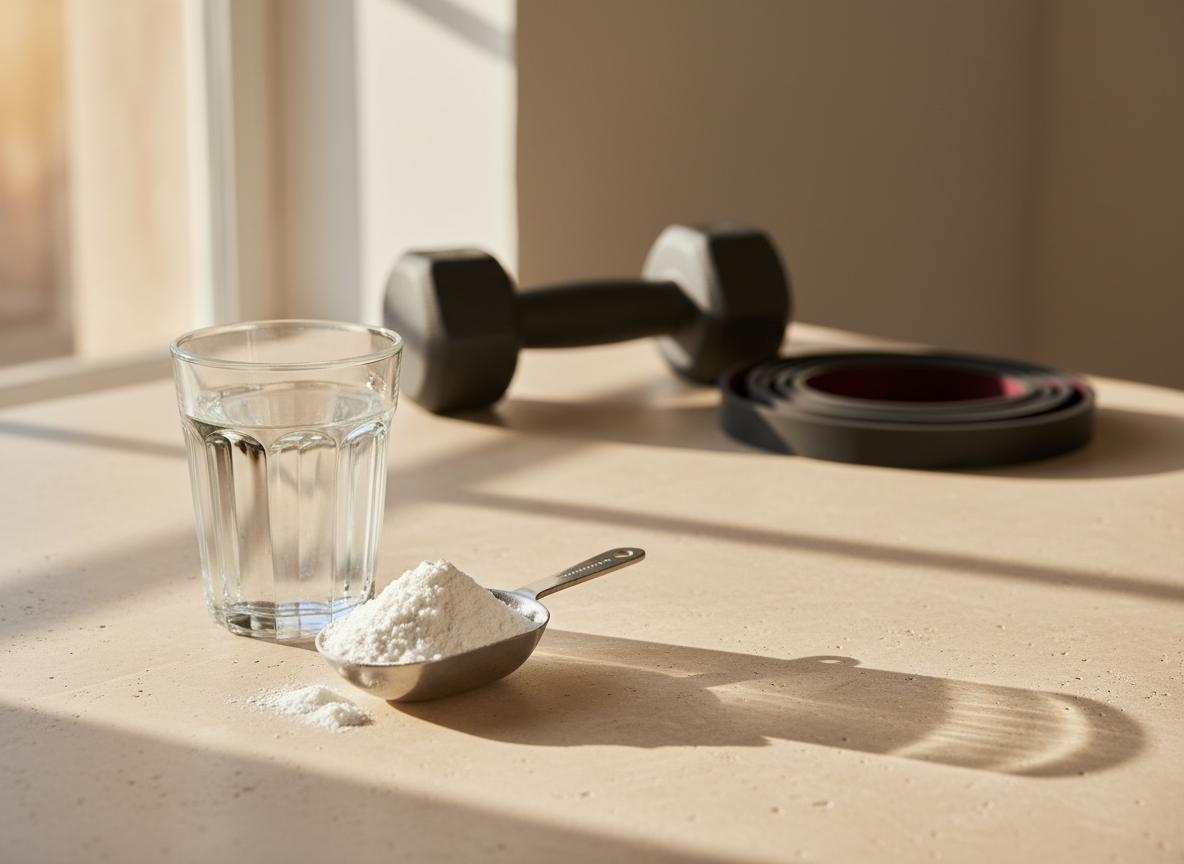
Creatine monohydrate is part of my current daily routine. I mention that for one reason: it is easy to confuse “I use this” with “everyone should use this.” Those are not the same claim.
Creatine is one of the few supplements with a substantial human evidence base, especially for strength and resistance training. It is also being marketed far beyond that evidence—as a brain booster, longevity aid, anti-aging supplement, and answer to problems ranging from fatigue to cognitive decline.
The useful question is not whether creatine “works” in the abstract. It is what outcome it may improve, in whom, under what conditions, and by how much. For adults over 50, the strongest case is fairly ordinary: creatine monohydrate may add a modest strength benefit when it is paired with resistance training. That is meaningful. It is also much narrower than much of the marketing.
Why creatine deserves attention—and restraint
Creatine is a compound the body makes from amino acids and stores mainly in skeletal muscle. Food—especially meat and fish—also supplies some. In muscle, creatine helps replenish adenosine triphosphate, or ATP, during short, demanding efforts such as lifting a weight, climbing stairs quickly, or getting up from a low chair.
That mechanism is real, but mechanism is not outcome. A biologically plausible explanation tells us why something might help. Human trials tell us whether the difference is large enough, consistent enough, and relevant enough to matter.
This distinction matters with creatine because it sits in an unusual position. It has better evidence than most supplements, which makes it easier for reasonable findings to become unreasonable claims. “Well studied” does not mean “proven for everything.”
What the human evidence supports after 50
A 2026 systematic review and meta-analysis included 11 randomized trials in adults age 60 and older. Compared with resistance training alone, adding creatine produced a small improvement in muscle strength. The reviewers rated that evidence as moderate certainty. Effects on muscle mass and physical function did not reach statistical significance, and confidence in those outcomes was low or very low.
That is a useful result, but it needs proportion. A small average improvement in strength can matter when maintaining strength supports independence. It does not mean creatine reverses frailty, prevents disability, or makes a weak training program effective. Most of the participants were generally healthy older adults, so the findings should not automatically be extended to people who are frail, have sarcopenia, or live with substantial functional limitations.
The hierarchy is still clear. Progressive resistance training does the main work. Adequate protein and recovery matter. Medical causes of weakness or muscle loss still need to be addressed. Creatine can sit on top of those foundations; it does not replace them.
There is also a measurement issue worth understanding. Creatine can increase water stored inside muscle cells, particularly early in supplementation. Some of the change reported as “lean mass” may therefore reflect water rather than newly built muscle tissue. That does not make the change meaningless, but it does mean a body-composition number cannot by itself prove new muscle growth.
The brain claims are ahead of the evidence
The brain also uses ATP, so the interest in cognition is not irrational. The problem is that plausible biology and promising findings are already being translated into claims that are much more certain than the evidence allows.
A 2024 meta-analysis of 16 randomized trials involving 492 participants found small benefits for memory and some timed cognitive tasks, but no clear improvement in overall cognition or executive function. The populations, doses, study lengths, and cognitive tests varied considerably. Another 2024 systematic review reached a more skeptical conclusion, and the European Food Safety Authority found the evidence insufficient to establish that daily creatine improves cognitive function.
That disagreement does not mean the question is closed. It means the claim should stay modest. Creatine may help certain cognitive tasks or certain groups, but it has not been shown to prevent dementia or to function as a general brain-enhancing supplement.
Another reason creatine interests me personally is epilepsy. I follow emerging research into epilepsy, brain energy metabolism, and the creatine–phosphocreatine system. A 2023 review of the field found that the anticonvulsant evidence for creatine was still largely preclinical, but the rationale is scientifically interesting: seizures place heavy demands on cellular energy, while creatine helps buffer and shuttle energy in tissues with rapidly changing demands.
The human evidence is early, but it is no longer nonexistent. In a small 2019 prospective study, 22 children with refractory epilepsy who were already using a ketogenic diet received supplemental creatine; some experienced substantial additional seizure reductions, but the study was open-label, uncontrolled, and too small to establish causation. More recently, a 2025 adult case report described a marked reduction in seizure frequency in one person with drug-resistant epilepsy after adding 5 grams of creatine monohydrate per day. I consider findings like these worth following, and the possible epilepsy-related benefit is one factor in my own decision to take creatine. But they do not establish creatine as an epilepsy treatment, and I do not treat my own use as evidence that it prevents or reduces seizures.
This is where supplement discussions often go wrong. An interesting signal becomes a headline, the headline becomes a promise, and before long the limitations disappear. Creatine does not need exaggerated claims to be useful.
How to use creatine without turning it into a project
The form with the deepest research base is plain creatine monohydrate. More expensive forms have not established a consistent advantage that justifies their cost.
- Typical daily amount: 3 to 5 grams.
- Loading is optional: Higher divided doses for several days can saturate muscle sooner, but a steady daily dose reaches the same destination more gradually and is often easier on the stomach.
- Timing is secondary: Consistency matters more than finding a perfect pre- or post-workout window.
- Pair it with the intervention that drives the adaptation: a progressive resistance-training plan suited to your health, ability, and goals.
If a larger dose causes bloating or loose stool, dividing the dose or using a smaller daily amount may help.
It is also reasonable to decide that the expected benefit is too small to justify another daily product. Something can be evidence-based and still not be necessary for everyone.
Kidney tests, safety, and who should be cautious
Creatine is converted to creatinine, a blood marker commonly used to estimate kidney filtration. Supplementation can therefore raise serum creatinine and make a creatinine-based estimated glomerular filtration rate look lower even when the kidneys have not been injured.
Recent systematic reviews of randomized trials found that creatine increased serum creatinine but did not show corresponding changes in other kidney measures such as urea or directly measured filtration. That is reassuring within the doses and populations that have actually been studied. It is not proof that creatine is appropriate for every person or that every medical circumstance has been tested.
If you take creatine, tell the clinician interpreting your laboratory results. In some situations, a clinician may use an additional marker such as cystatin C or a measured filtration test rather than assuming that a creatinine change represents kidney damage.
People with known kidney disease, unexplained abnormal kidney tests, significant fluid-management issues, complex medical conditions, pregnancy, or multiple medications should discuss creatine with an appropriate clinician before starting it. New or unexplained weakness, weight loss, or loss of function also deserves evaluation rather than being treated as a supplement problem.
Common practical effects include a small early increase in body weight from water stored with creatine and gastrointestinal discomfort, especially with large single doses. The evidence does not support the common claim that recommended creatine doses routinely cause dehydration or muscle cramps, but normal hydration still matters.
Synthetic creatine, manufacturing purity, and Creapure
Most supplemental creatine monohydrate is made through chemical synthesis. A common manufacturing route uses sodium sarcosinate and cyanamide, followed by steps that isolate and purify the finished creatine. Naming the starting chemicals can sound alarming, but it does not tell us what remains in the final powder. Creatine monohydrate has the same chemical identity whether it comes from a controlled manufacturing process or is compared with the creatine found naturally in the body. What matters for product quality is the identity and amount of any residual substances, not the word “synthetic” by itself.
That distinction should not become an excuse to overlook impurities. Manufacturing can leave residual compounds or produce by-products, including dicyandiamide (DCD), dihydrotriazine (DHT), and creatinine. A published 2011 analysis of 33 creatine supplements found that some products exceeded the impurity specifications used in the study. It was a small, historical market sample, not a reliable estimate of the quality of creatine monohydrate sold today. Nor does finding an impurity, without considering its concentration and toxicology, establish that a product causes harm at normal serving sizes.
One useful benchmark is Creapure, a branded creatine monohydrate ingredient made by AlzChem in Germany. Its publicly documented manufacturing specifications and traceability make its quality claims easier to examine than those of an unidentified bulk powder. Regulatory documentation submitted to the FDA describes a creatine monohydrate assay specification of approximately 99.9% and limits for manufacturing-related impurities. These are specifications for that ingredient and process, not proof that every retail package contains exactly the same measured values. An FDA “no questions” response to a GRAS notice is also not an endorsement of Creapure over competing supplements.
Does that make every non-Creapure product inferior? No. Another manufacturer can produce creatine monohydrate that meets comparable purity and safety specifications. The problem is that shoppers cannot verify equivalence from the words “100% creatine monohydrate,” “pharmaceutical grade,” or “micronized” alone. A credible comparison would examine current, lot-specific testing for creatine identity and assay, DCD, DHT, creatinine, heavy metals, and other relevant contaminants. Independent finished-product certification adds another layer of assurance, but the actual testing scope matters: a seal does not necessarily cover every manufacturing by-product.
For me, the sensible distinction is between documented quality and assumed quality. Creapure is a recognizable example of the former, not the only possible example. A well-tested generic product may be just as suitable. The evidence for creatine’s effects on strength or cognition does not settle the quality of a particular tub of powder, and a purity claim does not establish superior health outcomes. Those are separate questions, and readers deserve answers to both.
Product quality matters more than premium formulas
In the United States, dietary supplements are not approved by the Food and Drug Administration for safety and effectiveness before they reach the market. A product listing creatine monohydrate as its only active ingredient is easier to evaluate than a proprietary blend.
Independent quality seals from organizations such as NSF or USP can add useful assurance that the contents match the label and that contaminants are limited, although a seal does not prove the product will work for you.
Labels such as “micronized,” “buffered,” “advanced,” or “brain” should not be mistaken for comparative evidence. Marketing language is not research.
Where I land
Creatine monohydrate has a place in my own current routine. That is a personal decision, not evidence that everyone over 50 needs it.
What the evidence supports is more modest and, in my view, more useful than the marketing: creatine may add a small strength benefit when it is paired with resistance training. The cognitive evidence is interesting but unsettled. I am also following the emerging work on creatine, brain energy metabolism, and epilepsy because that possible benefit matters to me personally, but the human evidence is far too early to call creatine an epilepsy treatment. Claims about dementia prevention, broad longevity effects, and reversing age-related decline likewise go beyond what has been established.
That is enough. A supplement does not have to solve aging to earn a legitimate place. The better question is whether the likely benefit fits the problem you are actually trying to solve, and whether it adds something meaningful after the foundations are in place.
For a broader look at preserving independence, see Sarcopenia, Grip Strength, and Age-Related Muscle Loss. For the nutrition side of recovery and muscle maintenance, see Protein, Essential Amino Acids, and Healing.
Sources & Further Reading
- Yao L, Yang D, Gao J. Effects of resistance training combined with creatine supplementation in older adults: systematic review and three-level meta-analysis. Frontiers in Nutrition. 2026.
- Tsiaras A, et al. The effect of creatine supplementation on kidney function: systematic review and meta-analysis of randomized controlled trials. Journal of Renal Nutrition. 2026.
- Xu C, et al. The effects of creatine supplementation on cognitive function in adults: systematic review and meta-analysis. Frontiers in Nutrition. 2024.
- European Food Safety Authority. Creatine and improvement in cognitive function: evaluation of a health claim. EFSA Journal. 2024.
- Alraddadi EA, et al. Potential role of creatine as an anticonvulsant agent: evidence from preclinical studies. Frontiers in Neuroscience. 2023.
- Kalamitsou S, et al. The effect of creatine supplementation on seizure control in children under ketogenic diet: a pilot study. Integrative Molecular Medicine. 2019.
- Reduced seizure frequency with oral creatine supplementation: a case report. 2025.
- NIH Office of Dietary Supplements. Dietary Supplements: What You Need to Know.
- U.S. Food and Drug Administration. Questions and Answers on Dietary Supplements.
Disclaimer
Content on Real David Julian is provided for educational and informational purposes and may include research-based discussion, personal experience, and opinion. It is not medical advice and is not a substitute for individualized care from a qualified healthcare professional. Always discuss your specific health needs, diagnoses, medications, supplements, treatments, or major health decisions with an appropriate healthcare professional. See the full Disclaimer for additional information.