
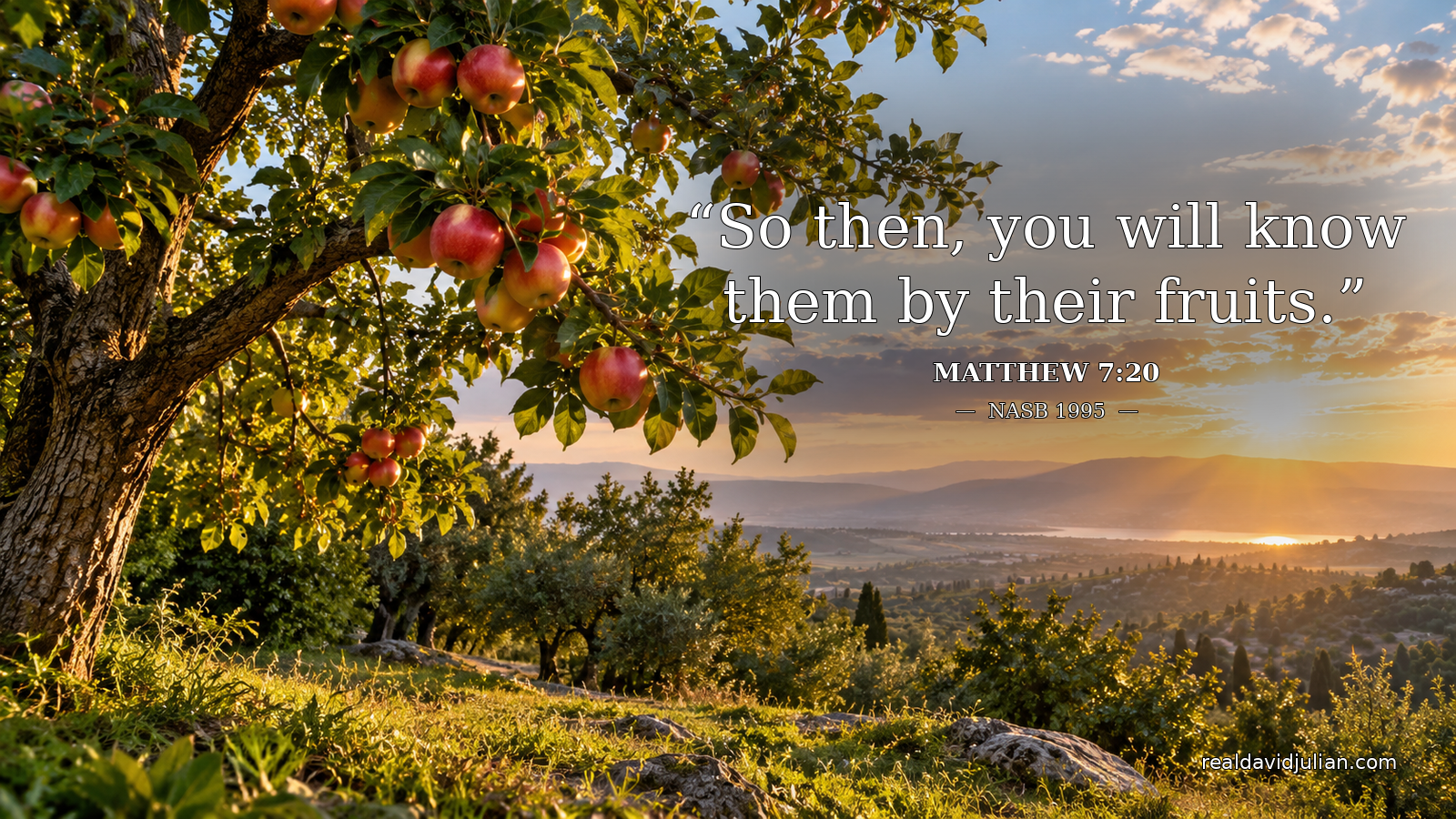
“So then, you will know them by their fruits.”
Matthew 7:20 — NASB 1995
Jesus’ words in Matthew 7:20 are short enough to remember easily, but they come at the end of a serious warning. He has told His listeners to beware of false prophets—people who can appear harmless while hiding something very different underneath. His picture is simple: a tree is eventually known by what it produces.
That matters because appearances can be persuasive. Religious language can sound convincing. Confidence can look like authority. A person can know how to speak to an audience, quote Scripture, attract followers, or make an impressive claim. Jesus does not tell His followers to accept those appearances as proof. He directs attention to fruit.
In the immediate context, Jesus is talking about false prophets. That keeps us from turning this verse into a license for casually judging everyone around us. The point is discernment—especially when someone claims spiritual authority or asks to be trusted as a teacher.
Fruit also requires more than a quick glance. Jesus’ image assumes something that takes time to become visible. One moment does not tell us everything about a person, just as one leaf does not tell us everything about a tree. Patterns matter. What does a teaching produce? Where does a person’s influence lead? Does what is being taught remain faithful to Christ and His Word? Does the life behind the message support the message, or repeatedly undermine it?
Those questions are especially important because the next words of Jesus make the warning even stronger. In Matthew 7:21–23, He describes people who call Him “Lord” and point to remarkable things done in His name. Outward religious activity, even activity that looks impressive, is not enough by itself. The appearance of spiritual success is not the same thing as faithfulness to Christ.
That should make us careful about the voices we allow to shape us. Popularity is not fruit. Charisma is not fruit. A large platform is not fruit. Neither are wealth, influence, emotional intensity, or the ability to say exactly what people want to hear. None of those things proves that a teacher is trustworthy.
But Jesus’ words are difficult to hear seriously without also allowing them to turn our attention inward. It is easy to become skilled at inspecting somebody else’s tree while ignoring our own.
What is our faith producing in ordinary life? What becomes visible over time in the way we speak, treat people, respond to correction, handle truth, make decisions, and follow Christ when there is nothing to gain from being seen doing it?
That is not a demand for flawless performance. Jesus’ image is about what a tree produces because of what the tree is. The question is not whether every day looks perfect. The question is what is actually growing from the life being lived.
Discernment, then, works in both directions. We should look carefully at the fruit of those who would influence our faith, and we should be willing to let the words of Jesus examine us as well. Neither requires suspicion or self-condemnation. Both require honesty.
Jesus does not ask us to be impressed by appearances. He asks us to pay attention to what is real.
Reflection
When you look beyond words and appearances—both in the people influencing you and in your own life—what fruit do you actually see?
Prayer
Father, give me discernment grounded in Your truth. Help me look beyond appearances and recognize the fruit of the voices I allow to influence me. Give me the same honesty when I examine my own life. Show me where good fruit is growing, where something needs to change, and where I need to listen more carefully to You. Keep me close to Christ and teach me to live faithfully before You. Amen.