
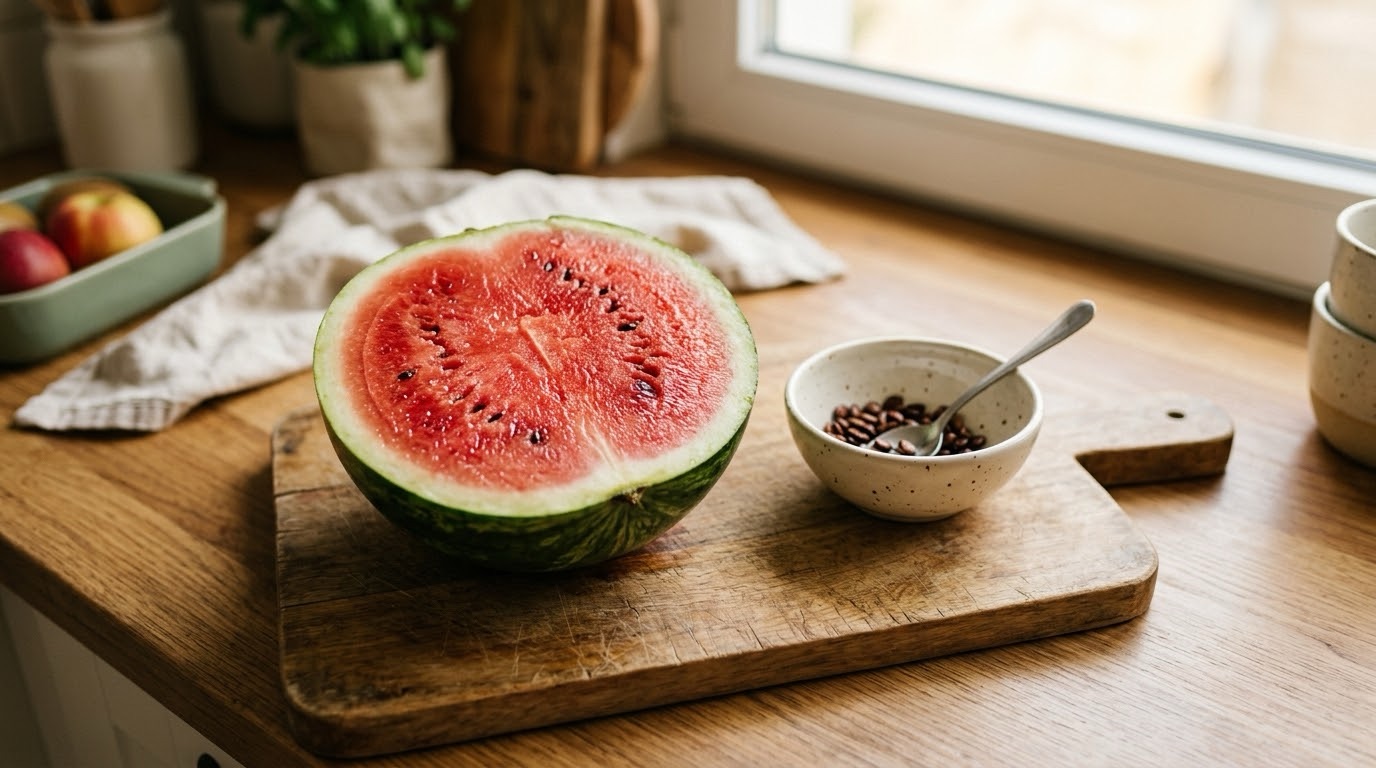
Most of what gets said about watermelon starts and ends with two facts: it’s mostly water, and it’s sweet. Both are true, but neither comes close to explaining why researchers keep publishing new studies on this fruit — including one the USDA released only days ago, giving an official nutrient profile to the part most people throw straight in the trash.
A watermelon isn’t really one food. The red flesh, the pale rind beneath the skin, and the seeds inside each carry a genuinely different nutritional profile, and treating them as interchangeable — or treating the rind and seeds as waste — means missing most of what the fruit actually offers. Here’s a full breakdown of what the current research shows: what’s established, what’s still emerging, and who should think twice before reaching for a big slice.
In This Article
- More Than Sugar Water: What’s Actually in a Watermelon
- The Citrulline Story: What the Research Actually Shows
- Lycopene and the Antioxidant Case for Watermelon
- Flesh, Rind, and Seeds: A Side-by-Side Comparison
- What the USDA Just Confirmed About the Rind
- Who Should Be Cautious
- Common Myths About Watermelon
- Getting More From the Whole Fruit
- Frequently Asked Questions
- The Bottom Line
More Than Sugar Water: What’s Actually in a Watermelon
A cup of diced watermelon runs about 46 calories and is roughly 91 to 92 percent water, which is exactly why it earns its reputation as a hydration food. But water content alone doesn’t explain the research interest. The flesh delivers a solid dose of vitamin C, some vitamin A activity from carotenoids, potassium, and small amounts of magnesium and B6 — a fairly ordinary produce profile, except for two compounds that show up in far higher concentrations here than almost anywhere else in the produce aisle: L-citrulline and lycopene.
Those two compounds, more than the hydration angle, are why watermelon keeps showing up in nutrition journals rather than just diet blogs — and why it’s worth understanding what the actual research says, rather than the shorthand version.
The Citrulline Story: What the Research Actually Shows
L-citrulline is a non-essential amino acid that the body can convert into L-arginine, the raw material for nitric oxide — a molecule involved in relaxing and widening blood vessels. Watermelon is one of the richest known dietary sources of it, first documented in detail by a 2005 USDA study that measured citrulline levels across the fruit’s different tissues.
A widely cited 2007 human trial found that adults who drank watermelon juice daily for three weeks saw measurable increases in fasting plasma arginine — 12 percent at a lower dose and 22 percent at a higher dose — while plasma citrulline itself stayed stable, which the researchers took as evidence that the citrulline was being actively converted to arginine rather than simply accumulating. That’s a genuine, replicated physiological effect. What it is not, based on the current evidence, is a proven treatment for any specific condition — the research at this stage supports a plausible cardiovascular mechanism, not a therapeutic claim.
Where the citrulline actually concentrates in the fruit is more complicated than most articles let on. Measured against dry weight, the rind consistently comes out higher in citrulline than the flesh. But rind is nearly 95 percent water, compared to about 90 percent for flesh, and once that moisture difference is corrected for — comparing the fruit the way it’s actually eaten, fresh weight rather than dried and concentrated — the flesh delivers more citrulline per bite than the rind does. A 2023 laboratory study using a human intestinal cell model confirmed this: flesh had the highest overall citrulline content of any part tested, even though skin and rind extracts showed stronger antioxidant activity. The honest takeaway is that the rind isn’t secretly the “real” citrulline source. It isn’t, once it’s eaten the way people actually eat it.
Lycopene and the Antioxidant Case for Watermelon
Lycopene is the carotenoid responsible for watermelon’s deep red color, and it’s one of the more extensively studied antioxidants in the produce aisle, researched for a possible role in reducing the oxidative stress associated with cardiovascular disease. A 2014 review in EXCLI Journal notes that watermelon is one of the few sources offering lycopene in its more readily available cis-isomer form. Per calorie, it’s also one of the more concentrated fresh sources of it — a genuinely useful distinction, since lycopene is more commonly associated with tomatoes, and tomatoes typically need to be cooked before their lycopene becomes well absorbed. Watermelon delivers its lycopene raw, with no cooking step required.
A small controlled 2019 trial in overweight, postmenopausal women examined daily watermelon intake alongside several markers linked to earlier-stage cardiovascular risk and reported favorable changes in several of them over the study period. That’s a promising early signal from a single trial in a specific population, not a settled finding — the kind of result that earns watermelon a place on a heart-conscious plate, not a claim that eating it prevents heart disease.
Flesh, Rind, and Seeds: A Side-by-Side Comparison
Laid out side by side, the differences become clear: the flesh is built for hydration and antioxidants, the rind adds fiber and citrulline at a very low calorie cost, and the seeds are the only part of the fruit offering meaningful protein, fat, and minerals.
| Characteristic | Red Flesh | White Rind | Seeds (dried kernels) |
|---|---|---|---|
| Water content | ~91% | ~92–95% | ~5% |
| Calories (per 100g) | ~30 | ~19–20 | ~557 |
| Primary sugars | Fructose, glucose | Minimal | Negligible |
| Protein | Very low | Low | ~28g |
| Fat | Negligible | Very low | ~47g, mostly unsaturated |
| Fiber | Low | Moderate | Moderate (shell removed reduces this) |
| Citrulline (as eaten) | Higher (fresh-weight basis) | Lower (fresh-weight basis) | Minimal |
| Lycopene | High | Low | Minimal |
| Vitamin C | Good source | Present | Minimal |
| Potassium | Good source | Present | Moderate |
| Magnesium, zinc, iron | Low | Low–moderate | High |
| Primary nutritional role | Hydration, lycopene, citrulline | Fiber, low-calorie bulk, some citrulline | Protein, healthy fats, minerals |
Figures are approximate and will vary with cultivar, ripeness, and growing conditions. Values are drawn from USDA FoodData Central and the peer-reviewed sources cited throughout this article.
What the USDA Just Confirmed About the Rind
The white layer just beneath watermelon’s green skin has always been technically edible, but it never had an official nutrient listing — until now. The USDA recently added a dedicated entry for raw, seedless watermelon rind to its FoodData Central database, the same government system used for the flesh. According to reporting on the new entry, the rind is roughly 92 to 95 percent water and comes in very low in calories — around 10 calories per 50-gram serving — while still contributing fiber, potassium, and vitamin C. Because this is a newly published dataset built from a limited number of samples, treat the specific figures as a useful starting point rather than a fixed number, and check the USDA’s live entry directly if you need precision for a specific use.
Watermelon Rind Nutrition per 100 Grams: Why the Numbers Vary
If you’re looking for watermelon rind nutrition facts per 100 grams, the most important point is that there is not one universal number that applies to every rind. Published measurements vary with cultivar, growing conditions, exactly how much white versus green tissue is included, and whether researchers report nutrients on a fresh-weight or dry-weight basis. Drying the rind removes water and makes nutrients look much more concentrated, so those figures should not be compared directly with fresh rind.
Fresh watermelon rind is mostly water and is generally low in calories while providing some fiber, potassium, vitamin C, citrulline, and other plant compounds. A recent review of watermelon by-products illustrates how wide the reported ranges can be across studies rather than supporting a single fixed profile. That is why I would rather give you the range and the limitation than publish a precise-looking 100-gram table that suggests more certainty than the evidence supports. For standardized values as they develop, the USDA FoodData Central entry remains the best reference point; broader research on rind composition can be found in this peer-reviewed review.
None of this means the rind is nutritionally superior to the flesh — it isn’t, particularly when it comes to lycopene and citrulline, as covered above. What it does mean is that the rind has a legitimate, complementary nutritional role rather than being pure waste. It can be blended into smoothies, shredded into slaw, quick-pickled, or added to stir-fries once the tough outer green skin is trimmed away.
Who Should Be Cautious
Watermelon is a whole food with a strong overall safety profile, but it isn’t universally trouble-free. A few groups genuinely benefit from more deliberate portions:
- People with IBS or fructose sensitivity. Watermelon is high in both excess fructose and mannitol, two categories of fermentable carbohydrate tracked on the low-FODMAP diet, and it can trigger bloating or digestive discomfort even in fairly small servings for people managing this kind of sensitivity. If digestive symptoms are already a pattern for you, this piece on fiber, bloating, and enzymes is a useful next read.
- People managing chronic kidney disease. Watermelon carries a moderate amount of potassium, and depending on the stage of kidney disease, potassium intake may need to be tracked carefully. If fluid intake is also being monitored, watermelon’s high water content is a second factor worth discussing with your care team. The NIH’s guidance on CKD nutrition is a good starting reference for that conversation.
- People managing blood sugar. Watermelon has a high glycemic index but a low glycemic load per typical serving, because it delivers relatively little carbohydrate for its volume — a distinction the Linus Pauling Institute uses watermelon itself to illustrate. Portion size still matters, and pairing it with a source of protein or fat can further blunt the blood sugar response.
- Young children, around whole seeds. Whole watermelon seeds present a genuine choking hazard for young children. Seedless varieties, or shelled and roasted kernels, are the more practical choice for that age group.
Common Myths About Watermelon
Myth: It’s basically sugar water with nothing else going on. The concentrations of citrulline and lycopene alone put that claim to rest — both are actively studied compounds, not marketing language.
Myth: Swallowed seeds will sprout in your stomach. This one has followed watermelon for generations and isn’t true — stomach acid prevents seed germination. Watermelon seeds are edible and, eaten shelled or roasted, are a genuine source of protein, healthy fats, and minerals.
Myth: The rind is inedible. The tough outer green skin isn’t especially pleasant to eat raw, but the white layer beneath it is edible and, as the USDA’s new entry confirms, nutritionally worthwhile — not simply diluted flesh.
Myth: Watermelon is dangerous for blood sugar. Its glycemic index is high, but a normal serving’s glycemic load is low because of how little carbohydrate it actually delivers per bite — a nuance covered in more detail above.
Getting More From the Whole Fruit
A few practical ways to get more out of a watermelon than most people do:
- Eat the flesh as you normally would — it’s where the lycopene, most of the citrulline, and the bulk of the vitamin C and potassium are concentrated.
- Save the white rind rather than discarding it. Trim away the tough outer green skin, then blend the pale layer into a smoothie, shred it into a slaw, or quick-pickle it.
- If your melon has seeds, don’t automatically spit them out. Roasted and lightly salted, they’re a genuinely useful snack — closer nutritionally to a small seed than to the fruit itself.
- If you’re managing blood sugar, IBS, or kidney function, keep portions moderate and pair the flesh with a source of protein or fat rather than eating a large serving on its own.
- A sharp produce knife and a stable cutting board make trimming the rind and separating the seeds far less tedious — the main reason most people never bother.
Farm Fresh To You Reader Referral
If a good watermelon has you thinking about where the rest of your produce comes from, Farm Fresh To You delivers organic produce boxes right to your door. This is my personal referral code, not a commission-based affiliate link — it gets you $15 off your first box.
Frequently Asked Questions
Is watermelon rind edible?
Yes. The white rind beneath the tough green outer skin is edible. It is high in water, contributes some fiber and micronutrients, and can be blended, shredded, quick-pickled, or cooked. The outer green skin is much tougher and is generally trimmed away.
Are watermelon seeds nutritious?
Yes. Dried or roasted watermelon seed kernels are nutritionally very different from the flesh: they are much more concentrated in protein, unsaturated fat, magnesium, zinc, and iron. Because they are also calorie-dense, they make more sense nutritionally as a seed or snack than as another serving of fruit.
Does watermelon flesh or rind contain more citrulline?
It depends on how the comparison is expressed. The rind can appear higher when measured on a dry-weight basis, but when the fruit is compared as people actually eat it — fresh, with its natural water content — the flesh can provide more citrulline per bite. That is why claims that the rind is automatically the superior citrulline source need context.
Is watermelon a problem for blood sugar?
Not necessarily. Watermelon has a relatively high glycemic index but a low glycemic load in a typical serving because it contains so much water and relatively little carbohydrate by weight. Portion size still matters, particularly for someone managing diabetes or impaired glucose regulation, and individual responses can vary.
The Bottom Line
Watermelon is more nutritionally interesting than its reputation as sweet, hydrating summer fruit suggests. The flesh is the strongest source of lycopene and a meaningful source of citrulline; the white rind is edible and adds a different mix of fiber, water, and micronutrients; and the seeds contribute concentrated protein, unsaturated fat, and minerals. None of those parts needs to be turned into a superfood claim. The useful takeaway is simpler: the whole fruit offers different nutritional strengths, and much more of it is usable than most people realize.
Disclaimer
Content on Natural Vitality Advocate is provided for educational and informational purposes and may include research-based discussion, personal experience, and opinion. It is not medical advice and is not a substitute for individualized care from a qualified healthcare professional. Always discuss your specific health needs, diagnoses, medications, supplements, treatments, or major health decisions with an appropriate healthcare professional. See the full Disclaimer for additional information.