
There is a difference between having peace and having everything settled.
We often assume that peace will come once the difficult questions have been answered, the problems have been resolved, or the circumstances that trouble us have changed. That expectation makes sense from a human standpoint. We naturally want to understand what is happening, know what comes next, and have some confidence that things will turn out well.
Psalm 131 offers a different perspective. In just three verses, David describes a kind of quietness that does not depend on having every answer.
The discipline of a quiet soul
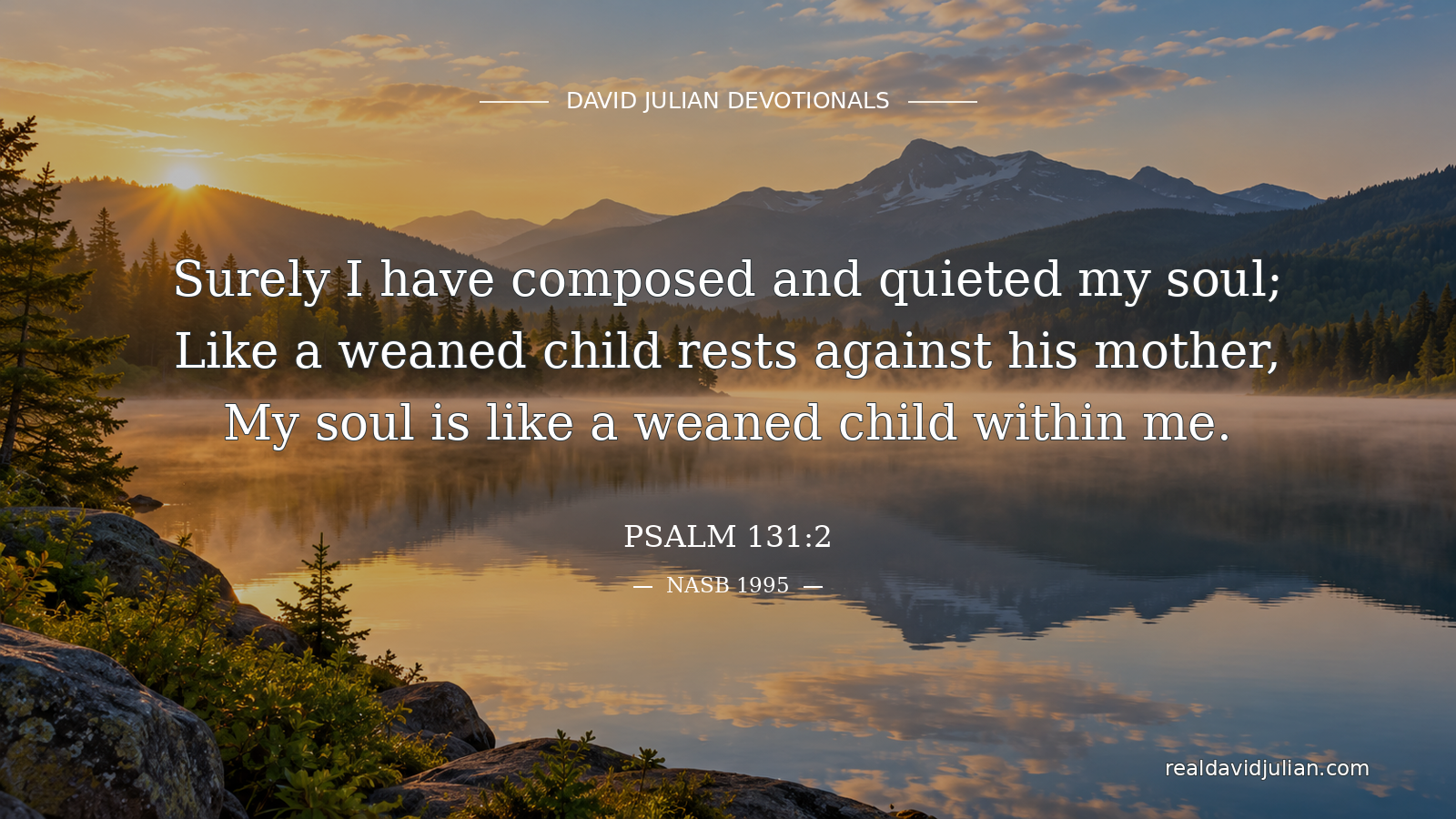
David writes, “Surely I have composed and quieted my soul; Like a weaned child rests against his mother, My soul is like a weaned child within me” (Psalm 131:2, NASB 1995).
The language is deliberate. David does not simply say that his soul became quiet. He says he has composed and quieted it. There is a measure of intentional restraint here—a refusal to let every unanswered question or unsettled circumstance govern his inner life.
The opening verse gives this quietness its context. David rejects pride and the presumption of occupying himself with matters too great for him. His quietness is connected to humility: recognizing that there are limits to what he knows, what he can control, and what he has been given to carry.
That is not the same as indifference. Humility does not require us to stop thinking, asking questions, seeking help, or taking responsibility. It requires us to recognize the difference between what is ours to do and what is beyond our reach.
Trust without complete understanding
David’s comparison to a weaned child is important. The picture is not of a child demanding to be fed, but of one able to rest in the presence of his mother. The emphasis is on settled trust rather than the immediate satisfaction of a demand.
This does not mean that faith eliminates grief, uncertainty, or difficult questions. Scripture gives us many examples of faithful people lamenting, wrestling, waiting, and asking God why. Psalm 131 does not cancel those prayers. It shows another posture that can exist alongside them.
A quiet soul is not necessarily a soul without trouble. It is a soul learning not to make its peace depend entirely on the resolution of that trouble.
The psalm ends by turning outward: “O Israel, hope in the LORD From this time forth and forever” (Psalm 131:3, NASB 1995). David’s quietness is not presented as a technique for managing emotions in isolation. Its foundation is hope in the Lord.
What quiet trust can look like today
There are responsibilities we should take seriously: decisions to make, people to care for, questions to investigate, and practical steps to take. Trust in God does not excuse neglecting those responsibilities.
But there is also a point at which continued mental effort no longer produces greater wisdom or more faithful action. We can revisit the same uncertainty repeatedly without changing what is possible. Psalm 131 invites us to recognize that limit.
Sometimes the faithful response is to act. Sometimes it is to seek counsel or wait for more information. And sometimes, after doing what can reasonably be done, it is to release our insistence on knowing how everything will turn out.
This kind of quietness may not come quickly. David’s words describe a practiced posture, not an effortless feeling. We can return to it without pretending that the questions have disappeared.
A question for reflection
Where am I continuing to carry a question or outcome after I have already done what is reasonably mine to do?
Prayer
Lord, teach me the humility to recognize my limits and the wisdom to carry my responsibilities faithfully. Help me distinguish between what calls for action and what I must entrust to You. When answers remain incomplete, turn my hope toward You rather than toward the certainty I cannot secure. Amen.